A Non-Traditional Medical Student Meets AI: My Journey

By: Karla P. Urgiles
Coming from a nontraditional background, I entered my first official year of medical school with thousands of hours of clinical experience across multiple specialties, as well as foundational medical knowledge gained from completing the first-year medical school curriculum through the IMS program at the USF Morsani College of Medicine. These experiences prepared me well. I already understood how to study effectively and had accumulated hundreds of notes and resources that had worked for me in the past. As a result, my transition into medical school was both smooth and academically successful.
So why would I change a study routine that was already working?
Just two months in, the volume, pace, and complexity of medical school material intensified, all while I was simultaneously stepping into the role of healthcare advocate for my mother, who was facing a serious medical challenge. Overnight, medical school was no longer my sole responsibility.
With limited time and mounting academic demands, it became clear that my existing approach was no longer sustainable. Studying longer hours was no longer an option; studying smarter became a necessity. I began searching for a method or resource that could truly optimize my study time while supporting long-term retention, conceptual understanding, and clinical reasoning—without compromising accuracy.
It was during this period that my curiosity about artificial intelligence began to take shape.
Drawing from my background in medical education, I understood the importance of mastering lecture objectives and reinforcing that knowledge through board-level, critical-thinking application questions. I began experimenting with tools such as NotebookLM and ChatGPT to assess whether AI could meaningfully support my learning—specifically by generating organized study guides aligned with lecture objectives and producing board-style practice questions to evaluate mastery.
At first, the results were promising. NotebookLM could organize content around lecture objectives into cohesive documents, and ChatGPT could generate case-based practice questions within seconds. However, as a self-described Type A learner, I could not rely on the material without verifying its accuracy. That verification process quickly revealed significant limitations.
While much of the AI-generated content was correct, it often contained critical omissions and intermittent inaccuracies. The practice questions presented similar issues, including incorrect answer choices or multiple correct answers where only one should exist. Attempting to make the tools usable required extensive reviewing, editing, and correction—effectively turning AI oversight into yet another layer of work.
I explored additional features, including NBLMs AI-generated podcasts and ChatGPTs conversational chat tools, but continued to encounter hallucinations, misinformation, and disorganized outputs. Most importantly, the information was not personalized to the way I learn best, limiting its effectiveness despite the platform’s breadth of features. Before long, I realized I was spending more time correcting AI-generated material and forcing myself to work around non-individualized outputs than actually studying.
That’s when it clicked, the “right” AI for medical education couldn’t simply deliver information—it had to be trustworthy and built around the learner, shaped by how each student studies, processes, and retains knowledge.I needed an AI that was accurate, organized, and reliable. One that didn’t pull information from anywhere on the internet and call it fact, but instead worked strictly from the material I provided and from credible, citable sources. It had to be available whenever I needed it—whether that was midday between lectures or at 3 a.m. during a cram session. It had to be patient enough to explain the same concept repeatedly until it finally clicked.By medical school, memorization alone isn’t enough. Success depends on understanding concepts deeply, retaining them long term, and being able to apply them to real clinical scenarios. That meant I needed an AI that could meet me at my level, adapt to my learning needs, and hold me to the academic expectations of medical education—all in one organized place, without forcing me to juggle multiple tools and resources.
For a long time, that kind of AI felt like a far-fetched idea.
Eventually, I stopped searching for the “perfect” AI tool and started building the conditions for one. In the process of designing intentional prompts, clear constraints, and learner-focused requirements tailored to medical education, it became clear which AI platforms could meet those standards—and which couldn’t. Working with an AI I could trust, I was able to create workflows that delivered the rigor, accuracy, and structure medical students need.
What began as a personal system quickly spread to peers and continued to work across different learners, courses, and study styles. That experience taught me something important: when AI is designed with clear boundaries and learner-centered intent, it can genuinely elevate medical education.
Discovering a Better Way to Learn
One evening, during what began as a mindless scroll on TikTok, I came across a video of a nursing student using StudyFetch to create a visual explainer directly from her uploaded lecture material. I was immediately intrigued. The idea that a YouTube-style teaching video could be generated in minutes—using one’s own course content—felt truly revolutionary. At least in my millennial perspective. I created a StudyFetch account that same night and began exploring the platform.
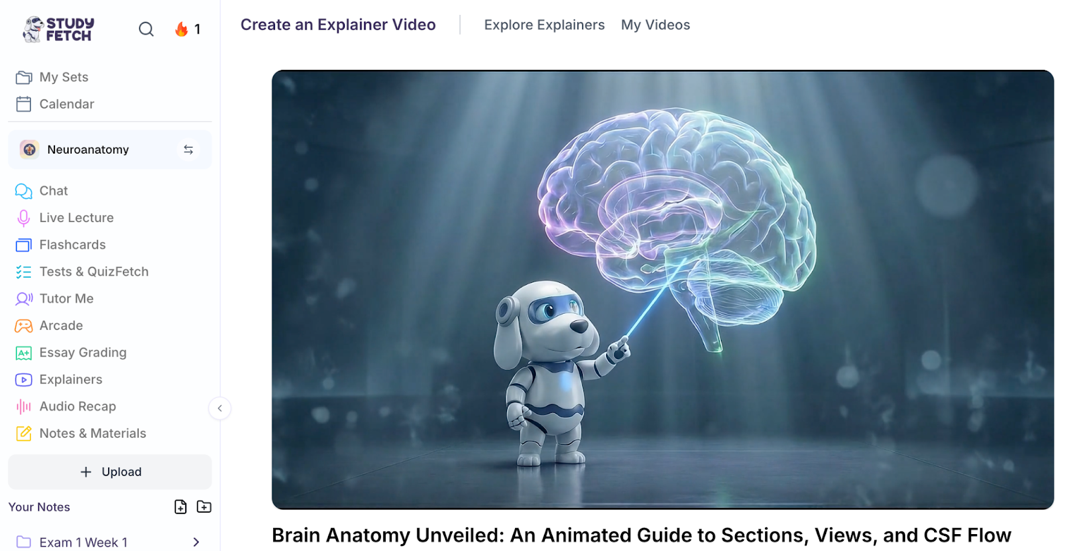
StudyFetch's Video Explainer Generator turns lecture slides and class materials into animated educational videos, allowing students to learn concepts through engaging , character-driven explanations.
The more time I spent on StudyFetch, the more I recognized its immense potential for students across disciplines. At the time, the platform did not yet offer medical-school-specific features. Nevertheless, the underlying technology was robust enough to generate medical-level study tools with thoughtfully crafted, user-generated prompts. I distinctly remember thinking, StudyFetch offers everything a medical student could need.
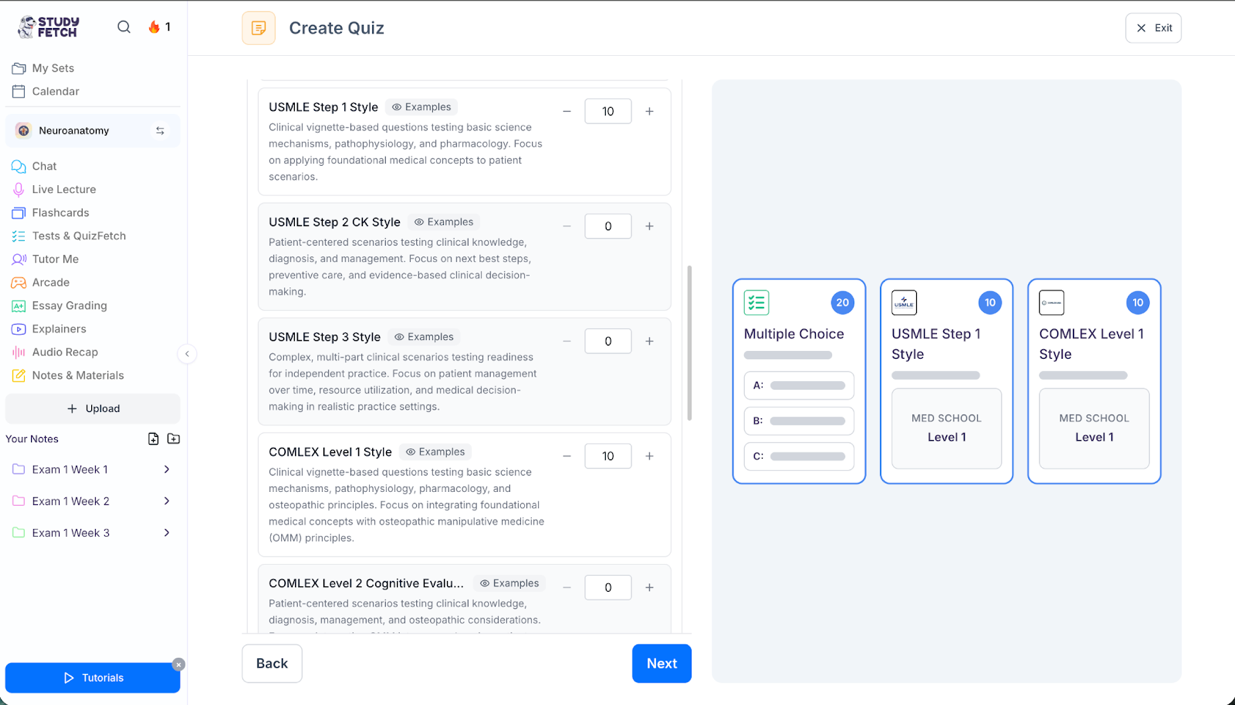
The StudyFetch Study Hub consolidates all study materials into one platform, offering tools to create notes, flashcards, and more, with integrated exam-specific study modes, including USMLE and COMLEX board preparation features.
From a personalized chatbot and structured notes to flashcards, higher-order practice questions, video and audio explainers, and even a live AI tutor capable of teaching in real time like a human instructor, the platform functioned as a comprehensive learning ecosystem. Most importantly, it was accurate, reliable, and tailored to my individual learning needs and personality.
As I continued integrating StudyFetch into my daily routine, it fundamentally transformed the way I approached learning. Through deliberate trial and error, I refined prompts into a finalized system that consistently produced medical-school-appropriate study tools and fully leveraged every feature on the platform. I now had a workflow capable of delivering high-quality personalized study materials in real time; within seconds to minutes, I could transform lectures into high-yield, board-relevant notes aligned with learning objectives in my Type-A organization style, create spaced-repetition flashcards to reinforce long-term retention, and generate USMLE- and COMLEX-style practice questions that tested true clinical reasoning rather than rote memorization, among many other applications. Best of all, I had my personalized tutor, Spark.E, built into the platform—ensuring I always had support while studying in the way I understand best.
Before I continue, let me introduce my bestie—Sparks. I mean, my tutor, Spark.E. But honestly, she’s my millennial, girly-pop bestie who also happens to double as my medical school tutor.
On StudyFetch, you can define the characteristics of your Spark.E tutor, customizing both its personality and how it delivers information based on your learning goals. Over time, Spark.E also learns from how you interact with the platform, allowing it to adapt even further.
The result is the most personalized AI learning experience I’ve encountered. Spark.E delivers memory hooks and analogies tailored to my interests, actively monitors my weak points, and explains concepts in a way that actually makes sense to my ADHD, millennial, girly-pop brain.
I mean—it literally gives me Bad Bunny–inspired memory hooks and even reality-TV-style podcasts.
As entertaining as this level of personalization was, what mattered most was whether it actually worked.
After consistent use, the results spoke for themselves. I enjoyed studying more, retained information longer, and saw measurable improvements in my exam grades, ranging from 5% to over 20%, across both systems courses and non-systems courses like Osteopathic Principles and Practice, Primary Clinical Skills, and Health System Sciences. At the same time, I reduced my daily study time by about an hour, making my learning more efficient and effective.